• On TechRepublic: Cracking open: $8K Alienware Area 51 ALX
April 11, 2008 4:00 AM PDT

Taking PCs apart--and sending them back to school

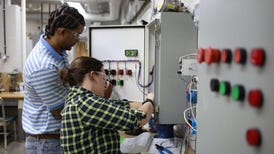
BOGOTA, Colombia--In one corner of a massive warehouse, workers pick through bins of computers, keyboards, and mice, painstakingly cleaning each part.

There's a special room where peripherals such as mice go for washing and another where they go for drying. Once the hardware is reassembled, often with a few new parts added to the mix, the first set of testing takes place, to make sure all of the hardware functions as it should.

Click here to read all of the stories in The Borders of Computing series.

Click here to read all of the stories in The Borders of Computing series.

In another area, the newly rebuilt systems get their collection of software--Windows 2000 and a several-generations-old version of Office. Then the machines go through another round of testing to make sure they are working properly, before being wrapped and packed in broken-down Styrofoam and being shipped out to destinations throughout the country.

Even printers are refurbished--and not just inkjet, but years-old dot-matrix printers that have long since been pushed out of the commercial market. It's all part of a project known as Computadores para Educar, which refurbishes thousands of computers each year for Colombia's schools.

Although the effort has given more than 9,500 schools their first PCs, some have begun to question whether the approach is the best way to go. Even the nonprofit agency itself has started to supplement the 20,000 or so computers it refurbishes each year with a separate manufacturing line that creates new machines.

One of the greatest strength's of the program is the rigor of its refurbishing process. Microsoft officials who toured the plant this week said the facility was among the best they had seen. Program officials say that a recent study found that the mean time before failure of their machines compares quite well against new machines, even though theirs are far older.

Among the criticisms is the fact that it costs about $160 to refurbish a PC. That figure is lower, say, than in Africa, but higher than in some other countries. It also is no longer so much less than a new PC, which can be had, sans software, for as little as $280.

One factor in the high cost for the program is the fact that the demand for the computers is so high that the program refurbishes nearly every donated PC that meets its minimum specifications--at least a Pentium II processor and 128MB of memory. As a result, the organization often has to supplement old parts with new. The parts that most frequently need replacement are system memory and hard disks, although new speakers and floppy drives (yes, each machine has a floppy) are often needed as well.

Click for gallery

Other say the machines are just too slow. Among those with that view is Dario Montoya, who heads the national SENA job training program.

In an interview after graduating a new crop of students from its SENA's IT skills program, Montoya said the refurbished computers won't help the country get the software developers it needs to truly compete.

"At this very table six months ago, I had the minister of communication and the minister of education," Montoya said. "I told them that Computadores para Educar must change."

Although the program has distributed around 100,000 computers, he said that 60 percent are now more than 6 years old. "They are obsolete," he said. "We cannot continue to fool ourselves that was a good model."

Cecilia Maria Velez, Colombia's education minister, said she thinks a mix of technologies is best. "We think that it's very important for quantity to use refurbished computers but we think it is also important to have other kind of machines," she said.

The Internet question
For her the question boils down to whether or not the machines can connect to the Internet. "The point is connectivity and capacity to use connectivity," she said. "That is the line."

Velez pushes back when she gets complaints that the machines are too old." I fight with them," she said. "Before you haven't anything; now at least you have this slow thing."

A teacher from the Funsa school, which has benefitted from the program, brought some students to see the facility here on Tuesday. Asked about the debate of old versus new, he said it all depends on the students. With elementary school students, he said, it's all about getting more time to interact with the machines. In those cases, more machines is better, even if they are older. By high school, though, he said the needs of students are simply outpacing the machines.

Maria del Rosario Guerra, an economist by training and now the country's communications minister, said she wants Computadores Para Educar to hit a critical mass of schools with their first computers in the next couple of years. "After that, Computadores para Educar must move to work toward new strategy."

During her years at CNET News, Ina Fried has changed beats several times, changed genders once, and covered both of the Pirates of Silicon Valley. These days, most of her attention is focused on Microsoft. E-mail Ina.
Recent posts from Beyond Binary
Microsoft to announce Silverlight 2.0 on Monday
Friday Poll: Which tech product is Joe Biden?
Microsoft exec: Challenging times play to our strengths
Should Microsoft buy Research In Motion?
Does Windows Cloud equal Windows Strata?
Add a Comment (Log in or register) 13 comments
On the right track
by razor.rodriguez April 11, 2008 6:05 AM PDT
It's true; the machines might be old but as mentioned, the students had none before. One thing to consider is the growing trend of on-line apps. Most of the computing occurs at the server side therefore there isn't a need for a fast computer. In a school environment, these machines could be configured as "thin clients" where they are essencially dumb terminals and all of the computing happens at the server. All you need is a new server.
Reply to this comment View reply
Great Program
by 8ballrunner April 11, 2008 7:13 AM PDT
The argument that many of these computers are simply too old is plain ignorant. I am a 25 year old who went to American public schools. In Pennsylvania as a first grader I was first taught on an early Macintosh computer, which had a mouse and a simple gui. However, upon moving to New York, we used Apple II computers. These computers were dinosaurs even by the standards then. However, the were able to teach me how to type as well as math skills (math blaster).
As long as the students are able to get some experience with computers they should be fine. Advanced computers really are not a requirement until a student reaches college level. The article also states that a refurbished computer costs $160, while a new computer would only cost $200+. That may not sound like a big difference, but if you multiply the cost difference by 100,000 that could be the difference with every student having access to a computer and only a fraction of the class.
Reply to this comment
Speed not a critical issue
by USA dad April 11, 2008 7:58 AM PDT
After reading this article I hear the usual argument that speed is so very important, but it is not as critical as many people would think. I think that every child should first have access to a computer, regardless of type, age or speed, so that they can first become accustomed to using computers and educational software, then so they can access the fantastic resources of the internet for it's teaching potential. As a child ages and enters high school and then college (if they ever get the chance to go that far), then they should have access to faster, more modern computers due to the need of more processing power for their studies.
I have refurbished numerous older computers which I then donated to less fortunate elementary schools and have watched children use them and thrive. For many, the slower computer is just what they need as they learn how to use it. In most cases, the children who have access to a computer of any kind learn at a faster pace than those who do not.
Speed and age of the unit is not really important. I have an old 380 MHz Compaq that runs Windows XP Home with no problem. It can run almost all of the latest educational software, and though slow, works as a great test machine for new software that I wish to try in the refurbs.
More power to the Columbians for taking the initiative to get computers into their schools and bringing their country's future into the 21st century.
Reply to this comment
Refurbishing is not sustainable
by waterloo_92 April 11, 2008 8:02 AM PDT
With hardware getting cheaper every day and the availability of open source solutions, its hard to argue that refurbishing is any cheaper. Over time, it is more expensive if you consider energy use, maintenance, training on older software, lower productivity of students etc. A new computer will have a much longer lifespan.
Reply to this comment View reply
Slow? No really!
by ethana2 April 12, 2008 10:43 PM PDT
Windows? Pssh.

Slap debian on those bad boys.
Reply to this comment
Recycle
by ethana2 April 12, 2008 10:44 PM PDT
If it's older than a Pentium III, send it back to tech companies so they can reuse the silicon, gold, and copper.
Reply to this comment
computer recycling
by bo1700 April 13, 2008 11:19 PM PDT
recycling is not sustainable? NO computer is better than a slow one? let those who dont like the idea of kids learning computing skills up thru elementary and middle school on less-than-cutting-edge technology put up some money to buy them the good stuff. "Dumping" older technologies to give kids without ANY computer experience or skills is a BAD thing? if that is what the government can afford, thats what they will get, and it will still be better than NOTHING. In addition they are training computer repairmen and women in jobs with a future. Its ridiculous to think otherwise.
Reply to this comment View reply
Try software tune-up
by mikenyc08 April 14, 2008 12:59 PM PDT
May be good idea to try software tuneup, I have find one at myquickpc.com it did good job on my pc.
-Mike.
Reply to this comment
Powered by Jive Software
advertisement

About Beyond Binary

During her years at CNET News, Ina Fried has changed beats several times, changed genders once, and covered both of the Pirates of Silicon Valley. These days, most of her attention is focused on Microsoft.


Beyond Binary is a look at how technology is changing our lives and the people behind all that life-changing stuff, with an extra emphasis on that which emanates from Redmond, Wash.

Add this feed to your online news reader

Beyond Binary topics

Binary Bits

    Follow Ina on Twitter (Twitter name: InaFried)

    Featured blogs

    advertisement
    advertisement

    Inside CNET News

    Scroll Left Scroll Right